In short
- Timber pole and rail is the cheapest and easiest to build on a hard site.
- Concrete sleepers and reinforced block carry more and last 50 years plus.
- Gabion, crib and rock walls are gravity walls that drain through the face.
- Height, load, space and access usually pick the type before looks do.
There are eight wall types you are likely to be offered for a house section in New Zealand. They differ in how they resist the ground, how much room they take, what they cost and how hard they are to get onto a site. This guide puts them side by side and then suggests how to choose.
Comparison at a glance
| Type | Guide price per m² | Expected life | Thickness |
|---|---|---|---|
| Treated timber pole and rail | $400 to $700 | 20 to 40 years | Slim |
| Concrete sleepers in steel posts | $600 to $1,050 | 50 years plus | Slim |
| Reinforced concrete block | $650 to $1,100 | 50 years plus | Slim, wide footing |
| Keystone-style segmental block | $550 to $950 | 50 years plus | Medium, more with geogrid |
| Gabion baskets | $450 to $850 | 50 years plus inland | Thick |
| Crib wall | $600 to $1,000 | 30 to 50 years plus | Thick |
| Stacked rock | $400 to $800 | Indefinite | Thick |
| Mortared stone | $800 to $1,500 | Indefinite | Medium |
Indicative ranges for each square metre of wall face, built and drained, on a site a small digger can get to. The firm figure is whatever the builder writes down after seeing the site.
Treated timber pole and rail
H5 poles concreted into the ground with H4 rails behind them. It is the default wall on New Zealand sections for good reasons: low cost, light components, quick to build, tolerant of small ground movement. Its limits are life span and load. It is the wall most likely to need replacing within your ownership, and it is not ideal under vehicles or against a building. Design detail is in the timber wall design guide.
Concrete sleepers in steel posts
Galvanised steel H-posts take the place of timber poles, and reinforced concrete sleepers slot between the flanges. It is built much like a timber wall, takes up about the same room and lasts far longer. Sleepers come plain or with a moulded timber or stone pattern. The parts are heavy, around 50 to 80 kg per sleeper, but can still be carried, which makes this the long-life option for restricted sites. See choosing sleepers.
Reinforced concrete block
Hollow masonry blocks on a reinforced concrete footing, with vertical steel through the cores and the cores filled with concrete. It is strong and thin, so it suits basement cuts, walls beside a house and walls under garages. It needs concrete delivered or pumped, an experienced blocklayer and nearly always an engineer. It can be plastered, painted or faced with stone.
Keystone-style segmental block
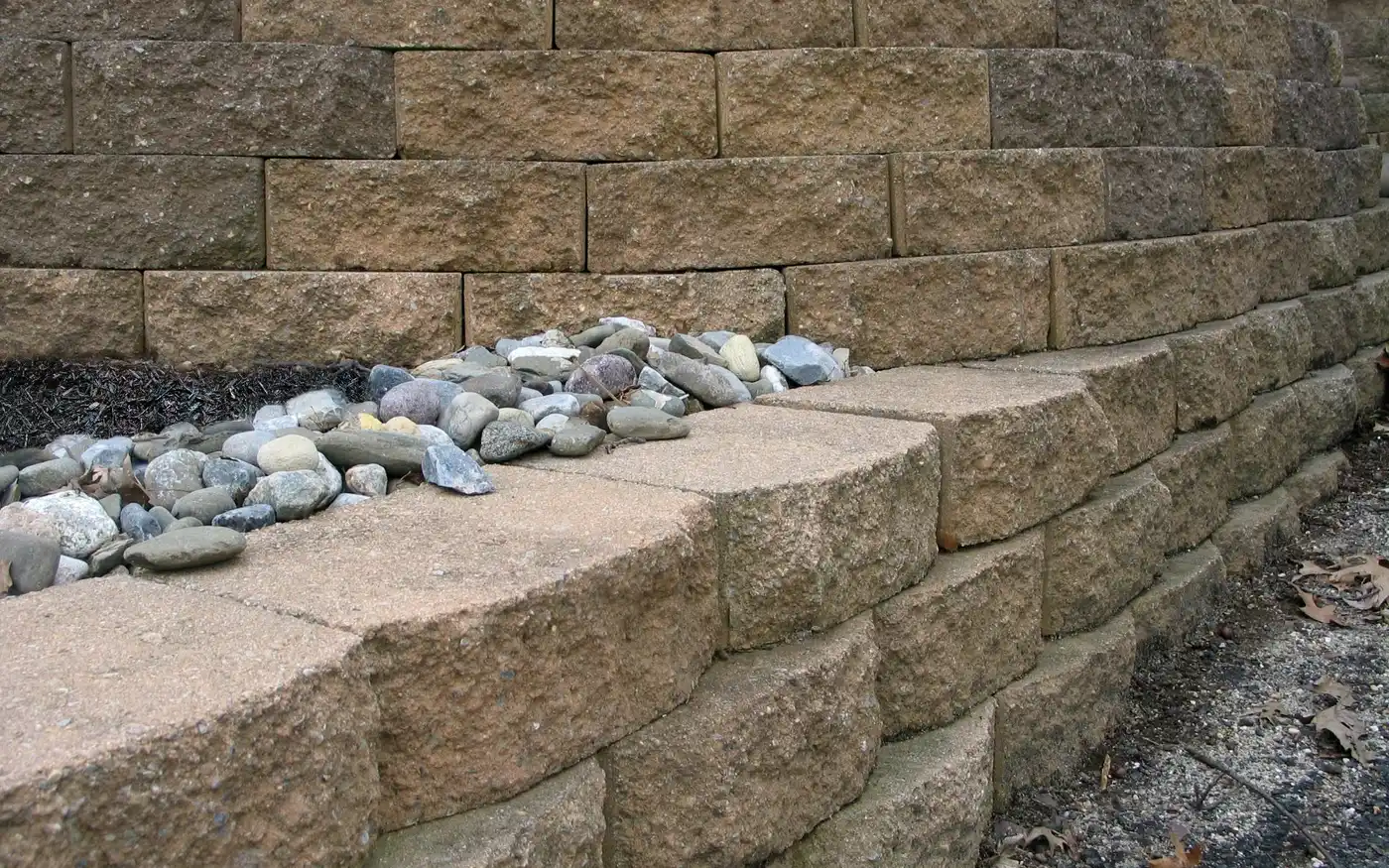
Dry-stacked interlocking concrete blocks that lean back into the bank. Low walls are pure gravity walls. Taller ones are reinforced with geogrid layers running back into compacted fill. They curve easily and look finished without any coating. They need space behind for the geogrid, which rules them out on many boundaries. Details in the Keystone wall guide.
Gabion baskets
Wire mesh boxes filled with hard rock. They are heavy, flexible and completely free draining, which suits wet banks, stream edges and slip repairs. They are thick, roughly as deep as they are high, and filling them by hand is slow. Mesh coating matters near the sea.
Crib walls
An open lattice of interlocking timber or precast concrete units, filled with drainage stone and built leaning into the slope. Common on older hillside streets and road cuttings. New concrete crib is durable. Old timber crib is often at the end of its life. The crib wall guide covers both.
Stacked rock
Large rocks placed by digger, each bearing on those below and tilted back. Cheap per square metre where rock is local and machines have room, and very long lasting. It needs a wide base and good machine access, and the finished face is rough. Above 1.5 metres it needs engineering like any other wall.
Mortared stone
Stone laid in mortar, either as a solid low wall or more often as a facing on a block or concrete wall. The most expensive and the best looking, used for entrances and street frontages. See stone retaining walls.
Less common types
- Poured reinforced concrete. Formed and poured in place. Used for tall walls and basements, mostly on new builds.
- Steel or timber soldier piles with lagging. Deep drilled piles with panels between, for tall cuts and slip repairs.
- Sheet piling, including fibreglass. Mainly waterfront work. See the fibreglass guide.
- Anchored and soil-nailed walls. Specialist engineering for unstable slopes.
How to choose
Start with height and load
Up to 1.5 metres with nothing on top, any type works and timber is usually the cheapest. Over that, or under a driveway or building, you are choosing between engineered timber, sleepers, block and concrete.
Then space
On a boundary or beside a path, slim cantilever walls (timber, sleeper, block) fit. Gravity walls (gabion, crib, rock, segmental block with geogrid) need a metre or more of depth.
Then access
If a truck and digger can reach the wall, everything is possible. If it is steps only, timber and concrete sleepers are the realistic choices, with pumped concrete where needed. In Wellington this single question often settles it.
Then water
A bank that seeps all winter suits a free-draining wall. A solid wall there needs serious drainage behind it. See the drainage guide.
Then looks and lifespan
For a wall you will see every day, or one that would be very hard to replace, it can be worth paying for concrete or stone. For a back bank nobody looks at, timber is hard to argue with.
A cost example across types
For the same wall, 10 metres long and 1.2 metres high (12 m²): timber is $4,800 to $8,400, concrete sleepers $7,200 to $12,600, segmental block $6,600 to $11,400, gabion $5,400 to $10,200 and mortared stone $9,600 to $18,000. More in the cost guide. For advice on your site, call 04 887 1262.
Questions people ask
Which retaining wall lasts longest?
Stone and stacked rock, which do not decay. Among built systems, reinforced concrete block, concrete sleepers and concrete crib are all expected to last 50 years or more when drained properly.
Which retaining wall is best for a steep section?
Usually timber pole and rail or concrete sleepers in steel posts, because the parts can be carried in and the walls are slim. The engineer may specify something else where the wall supports a building or driveway.
Is a block wall stronger than a timber wall?
A reinforced, filled block wall can carry more load for its thickness and lasts longer. For an ordinary garden wall under 1.5 metres, a properly built timber wall is strong enough and costs less.