In short
- Fibreglass retaining walls are mostly sheet piles for waterfront and wet ground.
- They do not rust or rot, which is their main advantage.
- They are uncommon on ordinary house sections in New Zealand.
- For most garden and boundary walls, timber or concrete sleepers are simpler and cheaper.
Fibreglass retaining walls come up in searches more often than they come up on building sites. The material is real and has good uses, but it is a specialist product in New Zealand. This guide explains what a fibreglass wall is, where it earns its place, and what most homeowners end up using instead.
What a fibreglass retaining wall is
Fibreglass, more accurately fibre-reinforced polymer or FRP, is glass fibre set in a plastic resin. For retaining it is made in two main forms.
- Sheet piles. Long corrugated or Z-shaped sections with interlocking edges. They are driven or vibrated into the ground side by side to form a continuous wall, usually with a capping beam along the top and sometimes with tie-backs.
- Panels and lagging. Flat or ribbed FRP planks that span between posts in place of timber rails or concrete sleepers.
Vinyl (PVC) sheet piling is a related product used the same way for lighter loads.
What it is good at
- It does not corrode. Salt water, acidic soil and constant wetting do not affect it the way they affect steel, and it does not rot like timber.
- It is light. Sections can be handled by two people and installed with small equipment, which helps on soft ground where heavy plant would sink.
- It forms a cut-off. Interlocked sheets hold back fine soil and limit water flow, useful beside ponds, canals and drains.
Where it is used
Almost all FRP and vinyl sheet piling in New Zealand goes into waterfront and wet-ground work: canal and marina edges, stream and pond banks, boat ramps, stopbank cut-offs and stormwater structures. On those sites the alternatives are steel sheet piles, which rust, or treated timber, which has a limited life in water.
Around Wellington the candidates would be things like a low wall along a tidal stream mouth, the edge of an ornamental pond, or protection beside a drain on the Kāpiti plain where the ground is sand and peat and the water table is high. Anything in or beside a waterway needs approval from the city or district council, and usually the regional council, before work starts. Coastal seawalls are a separate engineering field with their own consents.
Limits
- Stiffness. FRP is strong but flexes more than steel or concrete. Tall cantilever walls deflect unless they are tied back or made from deep sections.
- It has to be driven. Sheet piles suit sand, silt, soft clay and peat. They cannot be driven into rock or bouldery ground, which rules out most Wellington hill sections, where weathered greywacke is close to the surface.
- Engineering is always needed. There are no off-the-shelf residential design tables in common use here, so even a modest wall means a specific design.
- Supply. It is imported in limited profiles, and few residential builders have installed it.
- Look. It reads as an industrial product. Some profiles can be capped and faced, at extra cost.
- Sunlight. Quality products include UV protection. Cheap ones can chalk and become brittle over time.
How it compares
| FRP sheet pile | Treated timber | Concrete sleeper in steel posts | |
|---|---|---|---|
| Typical use | Waterfront, wet soft ground | General house sections | Boundaries, structural walls |
| Corrosion and rot | Unaffected | Rots eventually | Steel posts need coating |
| Works in rock | No | Yes, holes are drilled | Yes, holes are drilled |
| Design | Engineer every time | Tables or engineer | Tables or engineer |
| Availability in NZ | Specialist | Everywhere | Widely available |
What to use on a normal section
If what you want from fibreglass is a wall that will not rot, the practical answer for most properties is one of these.
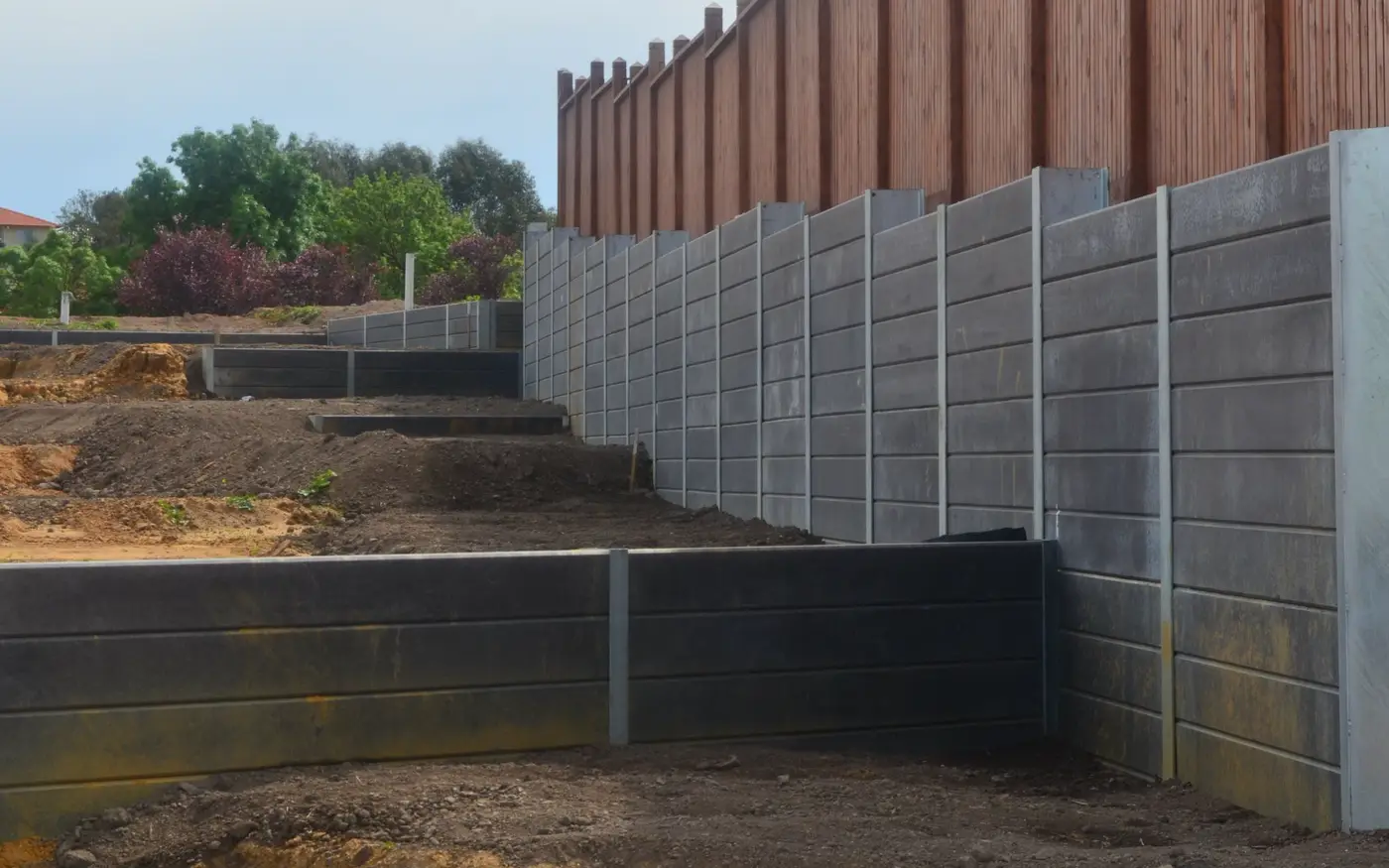
- Concrete sleepers in galvanised steel posts. Slim, long lasting and buildable on steep, hard-access sites. Guide price $600 to $1,050 per m² in Wellington.
- Reinforced concrete block. For walls beside the house or under a parking pad. $650 to $1,100 per m².
- Gabion baskets. For wet banks and stream edges where water needs to pass through. $450 to $850 per m².
- Treated timber with correct H5 and H4 treatment and drainage, where budget matters most. $400 to $700 per m².
As an example, a 10 metre boundary wall 1.2 metres high (12 m²) in concrete sleepers is $7,200 to $12,600. The wall types guide compares all the common systems, and the sleeper guide looks at timber against concrete.
If you think fibreglass is right for your site
- Confirm the ground can be driven: sand, silt or soft clay with no rock in the top few metres.
- Talk to the council early about consents, especially near water.
- Engage an engineer who has designed sheet pile walls.
- Ask the supplier for durability data and the names of installers.
For a conventional wall, call 04 887 1262 and we will arrange a visit from an independent Wellington retaining wall builder we partner with. They can tell you on site whether an ordinary system will do the job.
Questions people ask
Are fibreglass retaining walls used in New Zealand?
Yes, mainly as sheet piling for waterfront, canal and wet-ground work. They are rare on ordinary residential sections, where timber, concrete sleeper and block walls are simpler and cheaper.
How long does a fibreglass retaining wall last?
Good quality FRP with UV protection is marketed with a design life of 50 years or more, since it neither rusts nor rots. Ask the supplier for test data for the specific product.
Can fibreglass sheet piles be used on a hillside?
Generally not. They have to be driven into the ground, which does not work in rock or stony soil. Hillside walls are normally built with drilled posts or poured footings.
What is the best non-rotting retaining wall for a house section?
Concrete sleepers in galvanised steel posts for most boundary and garden walls, and reinforced concrete block where the wall carries a building or driveway.