In short
- Concrete sleepers in steel posts last longest: 50 years plus.
- New H4 treated pine sleepers are the best-value timber option.
- Old railway sleepers look good but carry creosote and vary in condition.
- Untreated macrocarpa suits low garden edges, not structural walls.
"Sleeper" is used loosely in New Zealand. It can mean a chunky treated pine board, a hardwood railway sleeper pulled from a track, or a precast concrete panel that slots into steel posts. All are used in retaining walls, and they are not interchangeable. This guide compares them.
The options side by side
| Sleeper | Typical size | Life in a wall | Best for |
|---|---|---|---|
| Treated pine, H4 | 200 x 100 or 200 x 75 mm | 20 to 40 years | Garden walls and rails for pole walls |
| New hardwood | 200 x 100 mm and larger | 25 to 40 years | Feature walls, heavier-duty timber walls |
| Recycled railway | About 250 x 150 x 2,100 mm | 10 to 25 more years, variable | Low rustic garden walls |
| Macrocarpa, untreated | 200 x 100 mm | 8 to 15 years in ground contact | Raised vege beds and edging |
| Concrete, in steel posts | 2,000 x 200 x 75 to 100 mm | 50 years plus | Boundary and structural walls |
Treated pine sleepers
The standard garden sleeper is radiata pine treated to H4, the hazard class for timber in contact with the ground. Used horizontally as the rails of a wall, between or behind H5 posts, it is economical and easy to cut and fix. Two cautions:
- Check the stamp. Some landscaping sleepers sold for edging are H3.2, which is for above-ground use and will not last buried.
- Pine sleepers stood on end as posts need to be H5, not H4.
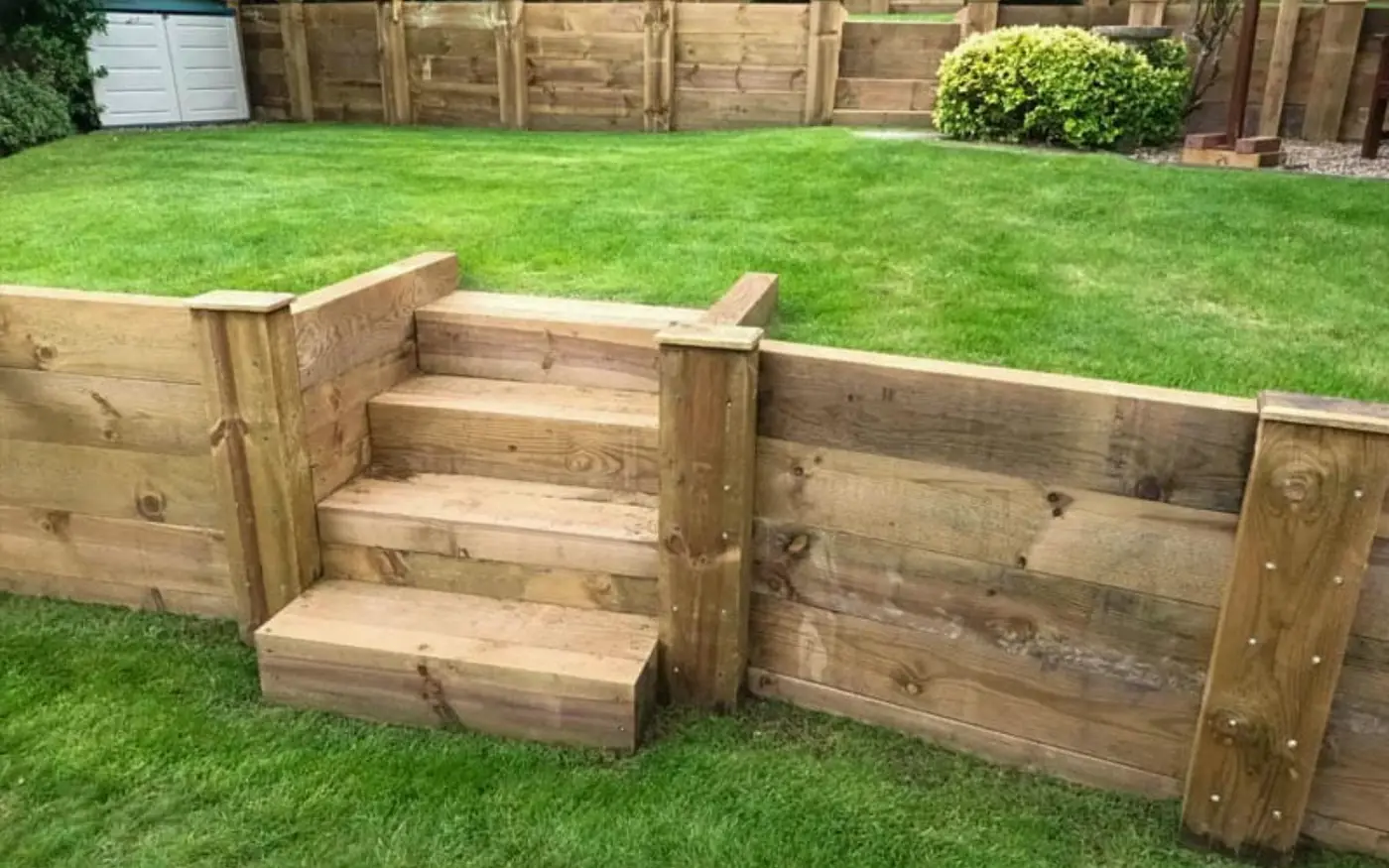
For low walls up to about 600 mm, sleepers can be stacked flat and pinned or screwed together with deadmen running back into the bank. Above that, they need proper posts. See the timber wall design guide.
Hardwood sleepers
New hardwood sleepers, mostly Australian species, are denser and naturally more durable than pine. They are heavy, harder to cut and drill, and cost noticeably more. They suit a wall where the timber is the feature. Fixings should be stainless, since the tannins in some hardwoods stain and corrode galvanised steel.
Railway sleepers
Recycled railway sleepers are popular for their weathered look. Before using them in a retaining wall, consider the following.
- Condition varies. They were removed from the track for a reason. Some are sound, others are split or soft in the middle. Each one needs checking.
- Creosote. Many were treated with creosote, which can weep in hot weather, smells, and marks skin and clothing. Avoid them for vegetable beds, play areas and seating.
- Weight. A hardwood railway sleeper can weigh 60 to 80 kg or more. On a steps-only section that is a real handling problem.
- Remaining life is unknown. Nobody can certify a second-hand sleeper for a structural wall, so engineers will not usually accept them for anything needing consent.
They are fine for a low, non-critical garden wall where the look matters and replacement would be easy.
Macrocarpa
Macrocarpa is widely used untreated for raised garden beds because people prefer no preservative near food crops. Heartwood has moderate natural durability. In constant ground contact it still decays within 10 to 15 years, sooner for sapwood. Use it for beds and edging up to a few hundred millimetres, not for a wall that holds back a bank.
Concrete sleepers
Concrete sleepers are reinforced precast panels, usually 2 metres long, that drop into the channels of galvanised steel H-posts concreted into the ground. The system has become the main alternative to timber for boundary walls.
- For: will not rot, burn or feed borer. Slim. Fast to assemble once posts are in. Available smooth or with timber-grain and stone-look faces. A fence can be fixed to extended posts.
- Against: higher material cost. Post positions must be accurate because sleepers are a fixed length. Each sleeper weighs 50 to 80 kg. Steel posts need heavier coatings near the sea.
Post sizes and depths come from the supplier's engineering tables for exempt walls, and from an engineer for anything over 1.5 metres or carrying a load. In Wellington guide rates are $600 to $1,050 per m² for concrete sleepers against $400 to $700 for treated timber. For a 12 metre wall 1.2 metres high (14.4 m²) that is $8,640 to $15,120 against $5,760 to $10,080.
Which is best?
For a boundary or any wall that is hard to replace
Concrete sleepers. The extra cost buys decades of extra life, and replacing a boundary wall later means disturbing fences, gardens and neighbours.
For a general garden wall on a budget
H4 treated pine on H5 posts, built with proper drainage.
For raised vege beds
Macrocarpa, or H4 pine lined with plastic if you want longer life.
For a rustic feature
Sound railway sleepers or new hardwood, kept low.
On a steps-only Wellington site
Treated pine is lightest. Concrete sleepers are still feasible with two people per sleeper, and are often chosen where the wall sits under a path or beside a neighbour.
Whatever you choose
The sleeper is only the face of the wall. Post depth and drainage decide whether it stays upright. Every sleeper wall needs a drain coil, drainage metal and filter fabric behind it, as set out in the drainage guide. The concrete walls page covers sleeper walls built in the region, and you can call 04 887 1262 for a written price.
Questions people ask
Are railway sleepers good for retaining walls?
For low garden walls where the weathered look is wanted, yes, if each sleeper is sound. They are not suited to structural or consented walls because their remaining life cannot be verified, and creosote-treated ones should be kept away from vege gardens and seating.
How long do treated pine sleepers last?
H4 treated pine in a well-drained wall typically lasts 20 to 40 years. H3 sleepers used in the ground can fail in under 10.
Are concrete sleepers worth the extra cost?
Where the wall is on a boundary, supports a path or fence, or would be awkward to rebuild, usually yes. They cost more up front and should last at least twice as long as timber.
Can sleepers be laid without posts?
Only for very low walls, up to roughly 600 mm, stacked flat, fixed together and tied back into the bank. Anything higher needs posts set in concrete.